
Students for Life endorsed a bill that would imprison people who have abortions. Was it ignorance, or an intentional shift toward criminalization?
;)
;)
;)

After years of denying that they seek to criminalize people who have abortions, Students for Life Action has endorsed a South Carolina bill that would do just that. S 1095 is a near-total abortion ban that would make it a misdemeanor to have an abortion, with a penalty of up to two years in prison and/or a $1,000 fine. It would also make is a felony to provide an abortion, manufacture medication abortion, or “aid and abet” an abortion. Students for Life endorsed this bill without reservation days after it was introduced in early April, marking the first time the group has publicly supported specific legislation that would punish people who have abortions. (Their press release has since been updated to add that they “hope the penalties against mothers will be removed.”)
Reproaction has warned for some time that the “pro-life” movement aims to criminalize people who have abortions, and this latest move makes it clearer than ever that Students for Life is out of touch with most Americans and even their own base when it comes to criminalizing abortion care.
Since the Dobbs decision, Students for Life leader Kristan Hawkins has insisted that she and the “pro-life” movement broadly don’t support criminal prosecutions for people who get abortions, but their actual record is murkier than “pro-life” advocates might like us to believe. In 2022, Hawkins said that “the pro-life movement has not and will not prosecute the women” who have abortions and co-wrote an op-ed with Susan B. Anthony Pro-Life America’s Marjorie Dannenfelser which read, “we state again emphatically that we oppose prosecuting women for abortion.” In a 2024 interview, Hawkins again claimed her movement “opposes throwing mothers in jail,” an approach she did not believe “has been or will be [her movement’s] focus.” She also co-signed a 2024 letter to North Dakota state lawmakers that said, “we state unequivocally that we do not support any measure seeking to criminalize or punish women and we stand firmly opposed to include such penalties in legislation.” The list of these types of comments from Hawkins goes on.
Despite denials from Students for Life that they want to criminalize people who have abortions, in 2019, Reproaction released a recording with former Students for Life spokesperson Autumn Lindsey Higashi saying, “If a woman kills a child outside the womb, then I think that she should be prosecuted for that. So, if a woman kills a child inside the womb, then I don’t think that there’s any difference.”
And now some of Hawkins’ own recent statements seem to contradict her organization’s ostensibly anti-criminalization stance, as she has begun to admit publicly that she is open to criminalizing people who have abortions, just not right now. On her podcast last year, Hawkins admitted she would be fine with laws that punish abortion patients once the “culture and laws shift.” This January, Students for Life invited anti-abortion activist Abby Johnson, an ardent supporter of criminalizing people who have abortions, to speak at their National Pro-Life Summit. During her speech, Johnson repeatedly called Hawkins a “friend” and “partner” in their efforts to “end abortion.” And just this past February, Hawkins embraced the label “incrementalists toward abolition,” signaling again that she may at some point support prosecuting people who have abortions. Funnily enough, this was in a Substack piece in which she complained about the pro-criminalization abortion “abolition” movement and her frequent squabbles with such groups, particularly around legislation introduced in South Carolina. Hawkins criticized abortion abolitionists, not for their eagerness to punish abortion patients, but for their insistence on “trying to kill every other [anti-abortion] bill” that doesn’t do that.
Though Hawkins has frequently sparred with abortion abolitionists in recent years, she has also stated that she actively ignores their legislation, which she admits makes her organization’s bills more likely to succeed. In a series of X posts in November 2025, Hawkins said that bills that criminalize abortion benefit her organization by positioning Students for Life’s proposals as comparatively more palatable to legislators.
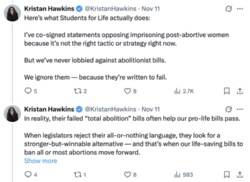
In February of this year, Hawkins reiterated that her organization does not actively oppose abolition bills and said that these bills make Students for Life’s model bills appear “moderate” in comparison—a benefit:
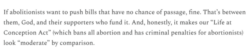
What Hawkins doesn’t say is that, by remaining silent on these bills, it also leaves the door open for her organization to support them in the future.
Students for Life demonstrated their approach to ignoring abolition bills in late 2025, when Hawkins passed up the opportunity to criticize an abolition bill in lieu of promoting her organization’s proposal. One day before a committee hearing of a South Carolina bill that would have allowed people who get abortions to be charged with homicide, Hawkins urged the South Carolina General Assembly to pass her organization’s model bill—the Human Life Protection Act—as “a common-sense” policy to “protect pre-born children … as well as mothers.” Her letter never mentioned the abolitionist-backed bill that was actually up for debate but seemed to imply that legislators should choose her model policy as a more moderate alternative.
Then this year, seemingly out of nowhere, Students for Life endorsed South Carolina’s S 1095, which would allow people who have abortions to be charged with a misdemeanor, resulting in a penalty of up to two years in prison and/or a $1,000 fine. Abortion abolitionists quickly took to social media to point out the apparent change in the organization’s stance on punishing people who get abortions. Students for Life then somewhat backtracked, with the Vice President of Students for Life Action implying they were in talks with legislators to “strip” the criminalization language and would withdraw their support if it was not removed.
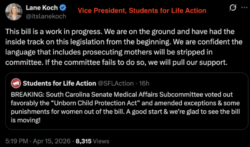
On April 21, the Senate Medical Affairs Committee advanced S 1095 with language that would make having an abortion a misdemeanor intact, sending it to the Senate floor. Despite their claims that they would pull support for the bill if the committee did not remove the language criminalizing people who have abortions, Students for Life was silent on the bill for weeks after that, neither confirming nor denying their continued support.
Then, on May 12, Kristan Hawkins posted on X complaining that the South Carolina Senate declined to extend its legislative session, which she said would have allowed them to consider S 1095 and another bill endorsed by Students for Life. So, it appears that Students for Life broke their promise to pull support for the bill if the Senate committee did not strike the language criminalizing people who have abortions. (As of the publication of this piece, the South Carolina legislature is in a special session with the primary goal of congressional redistricting, and there is still a possibility of anti-abortion bills advancing during the special session.)
Try as they might to deflect, Students for Life and Kristan Hawkins have already publicly signaled their openness to criminalizing people who have abortions, whether that’s Hawkins saying so herself on her own podcast, or Students for Life’s center-stage platforming of other anti-abortion leaders who support criminalization. Their muddled endorsement of South Carolina’s S 1095 seriously calls their credibility, consistency, and supposed commitment to opposing criminalization into question. How are Students for Life’s supporters (or even their critics) supposed to know if the organization genuinely backed the criminalization aspects of S 1095, or if they were simply ignorant of the bill’s content or cavalier about issuing endorsements? If Students for Life truly didn’t intend to endorse pro-criminalization provisions, does that mean the organization didn’t read or understand the bill, or does it mean they simply decided not to include caveats or reservations in their initial endorsement? And does their continued lobbying for the bill despite that language not being removed suggest that Students for Life is willing to endorse legislation that criminalizes having an abortion as long as it also contains Students for Life’s model bill language?
Whatever the case, any organization “firmly opposed” to criminalizing people who have abortions probably shouldn’t have allowed for such public confusion about its support for a bill that would do exactly that. Especially when Students for Life—an organization with a total 2024 revenue of $17.6 million for its 501c3 and $4.9 million for its 501c4—describes itself as “one of the leading pro-life advocacy organizations in the world, driving the narrative for the entire movement and leading by example.” Nevertheless, Students for Life appears wildly out of touch with the majority of Americans who want abortion to be legal in all or most cases.
If Students for Life really is the “pro-life” movement-leading organization it claims it to be, this could spell serious trouble for the anti-abortion movement—if other groups follow Students for Life’s lead, we may soon see more “pro-life” leaders come out in their open support of criminalizing people who have abortions. They do so at their peril: Americans especially do not want people who have abortions—or providers for that matter—to face criminal prosecutions. This includes people who may otherwise consider themselves “pro-life.” Recent polling suggests that even voters who believe abortion should be illegal in most cases much prefer laws that make it easier for people to have children, rather than punitive measures against those involved in abortions. Even the vast majority of Republicans don’t want people who have abortions to face legal repercussions, with Republican support for abortion being completely illegal dropping 41 percent since 2010.
But if the future the anti-abortion movement is working toward is one in which people who have abortions are put in prison, they should have the courage of their conviction to say so.